
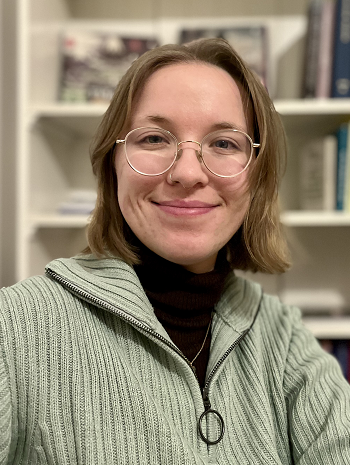
Lea Hüntemann M.A.
Landscape Archaeology and Architecture (LAA)
Prähistorische Archäologie
Institut für Prähistorische Archäologie
Fabeckstr. 23-25
14195 Berlin
Seit 03/2024
Wissenschaftliche Mitarbeiterin im DFG-Projekt "Landscape Archaeology in Thessaly" (LAiT)
Seit 10/2023
Promotionsstudium am Institut für Prähistorische Archäologie, FU Berlin
05/2023 – 10/2023
Predoc-Stipendium der BerGSAS
05/2023
Rudolf-Virchow-Förderpreis für hervorragende Magister-, Master- und Diplomarbeiten der Berliner Gesellschaft für Anthropologie, Ethnologie und Urgeschichte (für die Masterarbeit)
Seit 05/2022
Kulturvermittlerin in den Sonder- und Dauerausstellungen des Neuen Museums, Berlin
09/2021 – 03/2024
Stud. Hilfskraft im DFG-Projekt "Gebautes Wissen" (Werkvertragsbasis)
10/2020 – 04/2023
Mentorin am Institut für Prähistorische Archäologie, FU Berlin
10/2019 – 09/2022
Masterstudium der Prähistorischen Archäologie am Institut für Prähistorische Archäologie der FU Berlin
Masterarbeit: Magula Makrychori 3. A Neolithic and Chalcolithic site in the basin of Elateia, northeastern Thessaly, Greece. (Betreuerinnen Prof. Dr. Elke Kaiser, Dr. Agathe Reingruber)
09/2017 – 02/2018
Erasmus+ Studium an der University of Bath, UK.
10/2015 – 09/2019
Bachelorstudium der Englischen Philologie und Prähistorischen Archäologie am Institut für Englische Philologie und Institut für Prähistorische Archäologie der FU Berlin
Bachelorarbeit: Re-examining the Elgin Marbles in the context of France's restitution of cultural property to Africa (Betreuerinnen: Prof. Dr. Sabine Schülting, PD Prof. Dr. Doris Gutsmiedl-Schümann (MHEd))
Thessaly in the 5th millennium BC. Rethinking the transition from the Neolithic to the Chalcolithic Period
Since the early 20th century, the focus of research in prehistoric Thessaly is on the Neolithic period to which most of the tell-sites in the region belong. Little is known so far of the Chalcolithic period due to the lack of stratified settlements. Especially the transition from one to the other period is biased due to outdated research.
The purpose of this doctoral dissertation is to integrate the Chalcolithic period into the chronology of prehistoric Thessaly, which can be dated to the 5th millennium BC based on new C14 dates. The analysis will be focused on the material from Magula Agia Sophia, which was excavated in 1966 but not published fully. Additionally, surface material collected during recent surveys at sites in Eastern Thessaly will also be analysed. The aim will be to revise the relative chronology of the late Neolithic and early Chalcolithic, with emphasis on what is called the Rachmani period. The findings will be contextualised with results from new C14-dates and already published material.
2025
L. Hüntemann, 2025, The Magoula Makrychori 3: Pottery and small finds from the Neolithic and Early Chalcolithic periods. In: A. Reingruber, G. Toufexis (Hrsg.), Siedlungsdynamik in den Becken von Sykourio und Elateia, Nordost-Thessalien in prähistorischer Zeit. Ergebnisse der archäologischen, geomorphologischen und geophysikalischen Untersuchungen (Prähistorische Archäologie in Südosteuropa 34), 335–384.
2023
L. Hüntemann, 2023, Die Magula Makrychori 3: Ein neolithischer und chalkolithischer Fundplatz im Becken von Elateia, Thessalien, Griechenland. Ergebnisse einer Masterarbeit. Mitteilungen der Berliner Gesellschaft für Anthropologie, Ethnologie und Urgeschichte 44, 35-51.