
Sherouk Shehada M.A.
Ancient Languages and Texts (ALT)
Egyptology
Institut für Archäologie, Archäologie und Kulturgeschichte Nordostafrikas
Unter den Lindenn 6
10099 Berlin
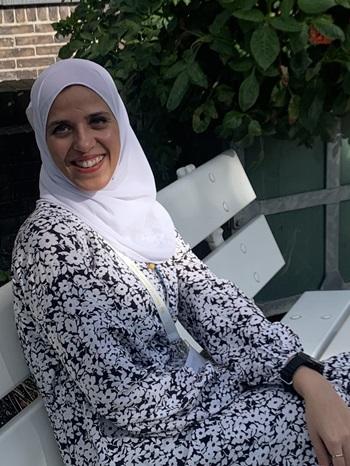
Sherouk Shehada is Assistant Lecturer of Egyptian archaeology at Helwan University (2020-present). She held the position of Teaching Assistant of Egyptian archaeology from (2014-2020). She is member on two Epigraphy missions, which hold in Sinai at Serabit el-Khadim temple with the German mission of Bonn University and Luxor at Padiamenope tomb (TT33), the French mission of Institut Français d’Archéologie Orientale (IFAO), Universities of Montpellier and Strasburg. Sherouk got her MA (Excellent) from Helwan University, Department of Archaeology and Civilization Egypt (2015-2020), thesis title: “Innovations in the Language of the Amarna Period: An Analytic Study of the Verbal System”. Published in: S. Shehada, 2024. "The Innovations of the Verbal System in the reign of Akhenaten (1352-1336BC)", in: G. Chantrain (ed.), Language, Semantics and Cognition in Ancient Egypt and Beyond. Yale Egyptological Studies 14, p. 197-230. She had her BA in Egyptian Archaeology from Helwan University (2008 and 2012). She taught many courses in Egyptian archaeology for BA students, including Egyptian grammar and archaeology. Sherouk primary areas of interest are the Ancient Egyptian language, philology, epigraphy, palaeography, Linguistic comparative studies, Cultural history, cultural interactions and early alphabetic writing. Her PhD application for a DAAD scholarship and a scholarship at the Berlin Graduate School of Ancient Studies (BerGSAS) within the doctoral program Ancient Languages and Texts (ALT) has been successful.
A Palaeographical Study of Egyptian Inscriptions in Serabit el-Khadim during the Middle and New Kingdoms
Serabit el-Khadim with its temple of the goddess Hathor is an ancient Egyptian site,located in southwest Sinai where mining expeditions used to extract copper and turquoise. Around 500 inscriptions from Middle and New Kingdoms (1985-1069 BC) are attested from this site. They are written in hieroglyphs, cursive hieroglyphs, hieratic, hybrid, i.e., script between hieroglyphic and hieratic and early alphabetic writing. Moreover, Serabit el-Khadim is place of origin of alphabetic writing that likely played a crucial role in the development of the Ancient scripts and even the modern once. The reason for using these different scripts is still unclear and this research will close this research gap.
Sherouk`s project centered upon inscriptions, their scribes, type of material, methods and tools used to produce them. The study of Serabit el-Khadim Palaeography will assist in identifying the role of scribes in shaping the written texts and some elements of visual culture and the anthropology of writing in ancient Egypt. The inscriptions are the angle that leads us to the sociocultural and sociolinguistic background of people and their historical writing systems inside a crucial contact area near the border between Egypt and the Levant in the 2nd millennium BC. The study of these inscriptions contributes to preserve the heritage of ancestors. Therefore, this will fit with the program of ALT and her over all research interest in linguistics and philology of the Ancient Egyptian language.
2026
S. Shehada 2026. “A Palaeographical Study on Some Selected Man-Signs from Serabit el- Khadim during the Reign of Amenemhat III”, in: Svenja A. Gülden, Tobias Konrad, Kyra vanvder Moezel, Ursula Verhoeven (eds.). 2026. Ägyptologische „Binsen“-Weisheiten V: Ausprägungen, Entwicklungen und Interdependenzen im hieroglyphisch-hieratischen Schriftsystem WO| Mainz im April 2024. Abhandlungen der Geistes- und sozialwissenschaftlichen Klasse, Einzelveröffentlichung Nr. 19. Stuttgart: Franz Steiner. Verlag. P. 207-225.
2025
S. Shehada, 2025 (accepted by the ICEXIII committee). “Hieroglyphic Palaeography of the Sun-Disc Sign in the Amarna Texts (1352-1327 BC)”.
2024
S. Shehada, 2024. "The Innovations of the Verbal System in the reign of Akhenaten (1352-1336BC)", in: G. Chantrain (ed.), Language, Semantics and Cognition in Ancient Egypt and Beyond. Yale Egyptological Studies 14, p. 197-230.
2020
S. Shehada, H., Sampaio, A., Correia and L., Brazão. 2020. “Analyzing Tourism Agents’ Perceptions of the Use of Artificial Intelligence”, in: de Carvalho J.V., Rocha Á., Liberato P., Peña A. (eds), Advances in Tourism, Technology and Systems. ICOTTS 2020, Smart Innovation, Systems and Technologies 208, Singapore, Springer. https://doi.org/10.1007/978-981-33-4256-9_22
S. Shehada. 2020. “The Conjunctive construction mtw.f sDm in the Language of the Amarna Period”, in Journal of Faculty of Arts, Menoufia University, Volume 31, Issue 121, Spring 2020, P. 2721-2734. https://journals.ekb.eg/article_147468.html